Correspondence systems differ by lineage. These are traditional study associations, not astronomical positions or factual predictions.
The central reading
Two orientations. One field of meaning.
Upright
planning
decision
future vision
restlessness
assessment
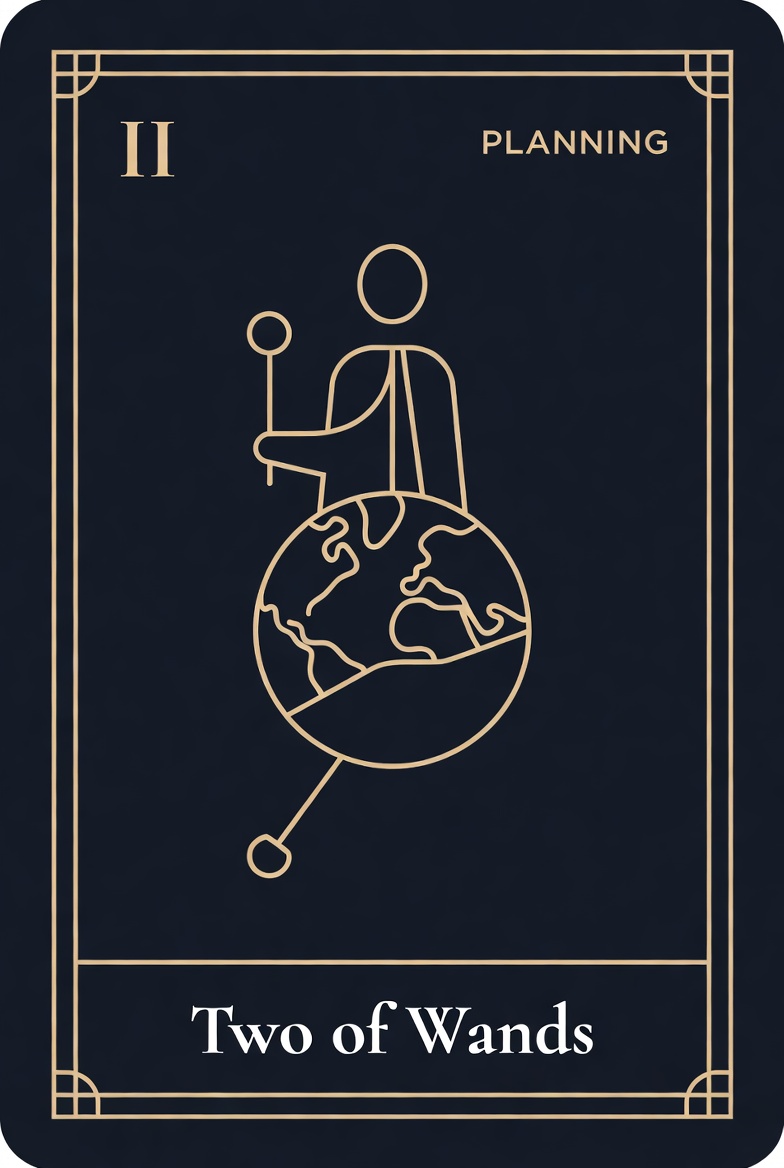
The Two of Wands is the card of standing at the edge of something you have built and looking at something you have not. The globe in the man's hand is the whole world reduced to a manageable object, which is precisely what planning does and precisely what it risks: the map is not the coastline. In a reading, this card indicates a genuine decision point where the safe option is real and the ambitious one is unproven. Mars in Aries gives it urgency and a certain impatience with deliberation. The card favours making the assessment properly and then actually moving, because its particular failure mode is not recklessness but permanent surveying. Standing on the battlement studying the horizon is only planning for so long. After that it becomes a comfortable substitute for going.
Reversed
indecision
playing safe
poor planning
fear of leaving
stalled ambition
Reversed, the Two of Wands describes ambition that has stalled at the analysis stage. Plans revised repeatedly, options weighed indefinitely, and a decision deferred until circumstances make it. It can also indicate choosing the known option out of fear rather than judgement, then constructing a persuasive rationale afterwards. Occasionally it points to a plan built on assumptions that were never actually checked.
Read the image
Symbolism before shorthand.
A man in a red robe and cap stands on the battlement of a stone castle, holding a small globe in his right hand and studying it. One wand is fixed firmly to the wall beside him; the other he grips loosely, suggesting he has one foot in what he has already built and one in what he has not. Below the battlement stretches a coastline, hills and open water. Carved into the stonework is a cross of roses and lilies, the union of desire and clarity that any serious decision requires. He has his back to the viewer and his attention on the horizon. The castle is comfortable, established, and entirely visible behind him.
Within the sequenceThe impulse of the Ace has been taken up, and now requires a decision about where to point it.
In context
Where the card meets a life.
01
Love & relationship
In love, it marks a decision about direction: whether to commit, whether to move for someone, whether a partnership can accommodate what each of you separately wants. It favours honest conversation about the long view rather than assumed alignment. Reversed, it indicates a relationship in indefinite assessment, where one or both people are permanently deciding rather than choosing, and the deferral has itself become the arrangement.
02
Work & direction
Professionally, this card sits at the point where a plan must become a move: the business idea that needs a first customer, the resignation drafted and unsent, the expansion agreed in principle. It favours a concrete next step over further modelling. Reversed, it warns of research substituting for action, or of staying somewhere secure while narrating an ambition you have taken no steps toward in two years.
03
Spiritual growth
Spiritually, the Two of Wands concerns the decision to leave a framework that is comfortable and no longer sufficient. The castle here is a genuinely good castle, which is what makes leaving difficult. Reversed, it describes recognising the limits of your current understanding while remaining inside it, because the alternative involves a period of not knowing anything reliably.
04
Shadow expression
The shadow here is dominion without departure. It surveys the horizon from a position of total safety, holds the world as a small object it has thoroughly understood, and mistakes the quality of its analysis for the courage it has never actually had to spend.
For the journal
Stay with the question.
01
What have I been planning long enough that further planning is now avoidance?
02
Which of my current assumptions about this decision have I never actually tested?
03
If the safe option is genuinely good, what specifically is it costing me?